Author Archives: alesk
ORA-600 [2252]
Sometimes ORA-600 can actually work for us ;-). Today, I powered on one of the PC’s that was offline for awhile and that it serves me as a test box. I didn’t spot anything weird until I tried to startup database to execute catcpu.sql from CPU Oct. 2010. I was greeted with the ORA-600 [2252] error:
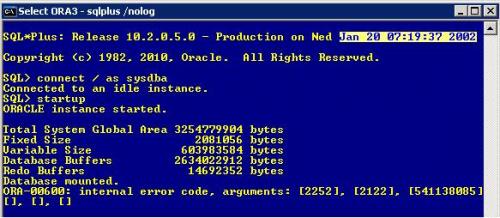
ORA-600 lookup tool (MOS 153788.1) correctly reported (see MOS 138701.1) that I should check system time, since this error is raised when kernel detects system time that is very different from what kernel is aware of. I marked with the yellow the system time. Obviously CMOS battery run out of juice on this box and needs a replacement.
Doesn’t happen very often that ORA-600 works for me and not against me :).
Oracle SQL Developer Data Modeler is a FREE product
Today I was pleasantly surprised when I saw the news on my favorite public forum that Oracle SQL Developer Data Modeler is a free product.
In the time when I feel that system analysis is a bad word among youngsters, something that only old school mastodons still practice and preach (or at least they’re trying to), came Oracle announcement that Oracle SQL Developer Data Modeler is available for free, quite a drop from 3000$ per named user price. I’m sure they were trying hard to sell the (overpriced!) product, but they simply could not make a significant sell figures. Golden times when Oracle Designer ruled the scene are over.
I truly hope that Oracle decision is correlated more to the economic downturn than the fact that nowadays system analysis is often neglected phase in the project, so one would expect smaller demand for the modeling tool such as SQL Developer Data Modeler.
I’m sure this is not a good news for Quest – while Toad Data Modeler is reasonably priced, it doesn’t run on Linux and this is becoming a major issue for me. I’m sure we’ll immediately freeze additional Toad Data Modeler purchases of new licenses and investigate the possibility to migrate to Oracle SQL Developer Data Modeler.
SIOUG 2010
We’ll see if economic downturn has any impact on attendance of fifteen conference organized by SIOUG! I hope not. SIOUG 2010 conference, two and a half day event hosted in my beloved Portorož is approaching and once again, I was questioning myself if is it worth spending more than a day or two on the conference. Despite my initial pessimism, I put together itinerary that justify a bit my discomfort with the conference venue. Here it is:
Monday, September 27
Christian Antognini, “Join techniques”
Boris Oblak, “Vodenje revizijskih sledi brez posegov v aplikacije”
Kantamestarit Oy,”Dude, where’s my database?”
Randolf Geist“Advanced Oracle Troubleshooting – Live Session”*
[*Although Graham Wood session on Exadata is tempting too.]
Tuesday, September 28
Uroš Mesojedec, “Java 2010 – pogled v prihodnost”
Jože Senegačnik,”Pravilna uporaba SQL ukazov v PL/SQL kodi”
Peter Robson,”CTRL-Z in SQL*Plus – Infinite Rollback!”
Piet de Visser,”Still using Ratios”
Graham Wood,”DB Time-based Oracle Performance Tuning: Theory and Practice”
Jože Senegačnik,”Kako lahko z definiranjem “constraintov” pohitrimo izvajanje aplikacij?”
Andrej Žabkar,”Virtualizacija z OracleVMjem – razgrnimo tenčico”
Wednesday, September 29
Grant Ronald,”The Fusion Development Platform”
Gregor Malenšek,”Kaj pa prehod na Forms & Reports 11g?”
Darko Golec,”Workspace Manager za potrebe časovnih baz”
Robert Korošec,”Oracle DataWall – nadaljevanje Oracle *Vault strategije”
Jure Kajzer,”Oracle za spletkarje”
Lovro Vreš,”Kdo dostopa do moje baze”
Denis Đukić,”Varnostno preverjanje Oracle podatkovnih baz”
If I’ll learn something worth posting, I’ll do it in the comment section.
ASRock mini – Part 4.
Just a quick note about ASRock running Windows 7 as a guest on Ubuntu (Lucid Lynx) host. The sole purpose of having Windows guest on my Ubuntu is to run Cisco VPN client that I need for remote access to my office (unfortunately, our “corporate” policy supports only VPN client for Windows) .
I’m happy to report that ASRock with 2GB RAM (256MB is used for graphic card) and dual core Atom 330 (1.6 GHz) processor is more than sufficient to run Windows 7 as a guest with 768MB RAM and one virtual CPU under VirtualBox 3.2. And that’s pretty much all I need from Windows 7 – to run VPN client plus Remote Desktop.
The only peculiarity I delved with VirtualBox on Ubuntu 10.04 was the following warning that I got during the guest startup:
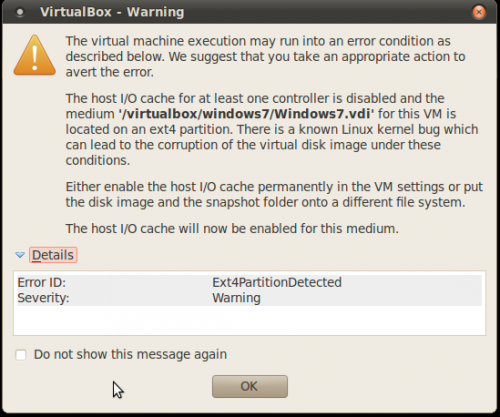
which I fixed by following the recommendation and turning the Host I/O cache on:

ASRock mini – Part 3.
In part 3 I’ll show how did I prepare my ASRock powered Ubuntu workstation at home with necessary tools related to my programming in python 2.6 and 3.1.
Fair warning: if I have a choice to install some software on Linux with official package manager, then I’ll always prefer this way over installing from source, no matter how recent source might be. That means that I’m not necessarily getting the bleeding edge packages, but on the other hand I’m sure I’m getting in return a stable, secure and easy to maintain system that takes care of dependencies during installation, uninstalls software for me, installs security fixes for me etc.
# -------------------------------------
# install python 3.1 (python 2.6
# was already installed)
# -------------------------------------
$ sudo apt-get install python3.1

# -------------------------------------
# Install setup tools for 2.6 and 3.1
# -------------------------------------
$ sudo apt-get install python-dev python-setuptools
$ sudo apt-get install python3-dev python3-setuptools

# -------------------------------------
# install IDLE for both, 2.6 and 3.1
# You'll find shortcuts for IDLE under
# Applications -> Programming
# -------------------------------------
$ sudo apt-get install idle-python2.6
$ sudo apt-get install idle-python3.1

# -------------------------------------
# Install PyQT 4 (4.7.2 is current
# version in ubuntu deb repository)
# -------------------------------------
$ sudo apt-get install python-qt4
$ sudo apt-get install python-qt4-doc
$ sudo apt-get install pyqt4-dev-tools
$ sudo apt-get install qt4-designer
$ sudo apt-get install qt4-dev-tools

# --------------------------------------
# Installing cx_Oracle (5.0.4)
# (see above section in which I
# already installed setuptools,
# easy_install won't work without them!)
# --------------------------------------

# I'm using Oracle11g R2 on Lucid Lynx

$ export ORACLE_HOME=/oracle/ora11
$ export LD_LIBRARY_PATH=$ORACLE_HOME/lib
$ export PATH=$ORACLE_HOME/bin:$PATH

# for python 2.6
$ sudo -E easy_install cx_Oracle

# for python 3.1 run:
$ sudo -E easy_install3 cx_Oracle

# ------------------------------
# Installing cx_Freeze
# ------------------------------

# for python 2.6
$ sudo apt-get install libssl-dev
$ sudo -E easy_install cx_Freeze

# if you're using python 3.1
$ sudo apt-get install libffi-dev
$ sudo -E easy_install3 cx_Freeze

# Install Eric (Python/Ruby) IDE
# --------------------------------------
$ sudo apt-get install eric

 dbaportal.eu
You must be logged in to post a comment.